Costs and pricing
Budget for B2B influencer marketing costs and pricing
A cost and pricing guide for B2B influencer marketing in England, covering campaign fees, talent rates, agency retainers and the tax rules that shape real budgets.
What to take away
- Most B2B influencer marketing budgets are built from three cost pools: creator fees, agency or management fees, and production or distribution costs. A realistic England pilot sits between £8,000 and £30,000 for a three-month programme.
- Creator fees are usually priced per deliverable or per campaign, not per follower count. A single LinkedIn post from a niche B2B expert might cost £500 to £3,000, while a multi-part thought leadership series runs higher.
- Employer costs matter. If you hire in-house staff or pay creators as contractors, National Insurance and pension thresholds change your true cost base, so check HMRC's published employer rates and thresholds before you sign off.
- Paid amplification is a separate line. LinkedIn advertising costs vary by targeting and format, so ask the platform for its current pricing guidance before you set a media budget.
- Build a contingency of 10 to 20 per cent. Hidden costs such as usage rights, exclusivity clauses and content reshoots are common in B2B deals.
- All figures in this article are illustrative planning assumptions, not market averages.
How are B2B influencer marketing costs structured?
B2B influencer marketing costs break into four buckets. First, the creator fee, which pays for content and distribution to their audience. Second, agency or talent management commission, typically 15 to 25 per cent on top of the creator fee.
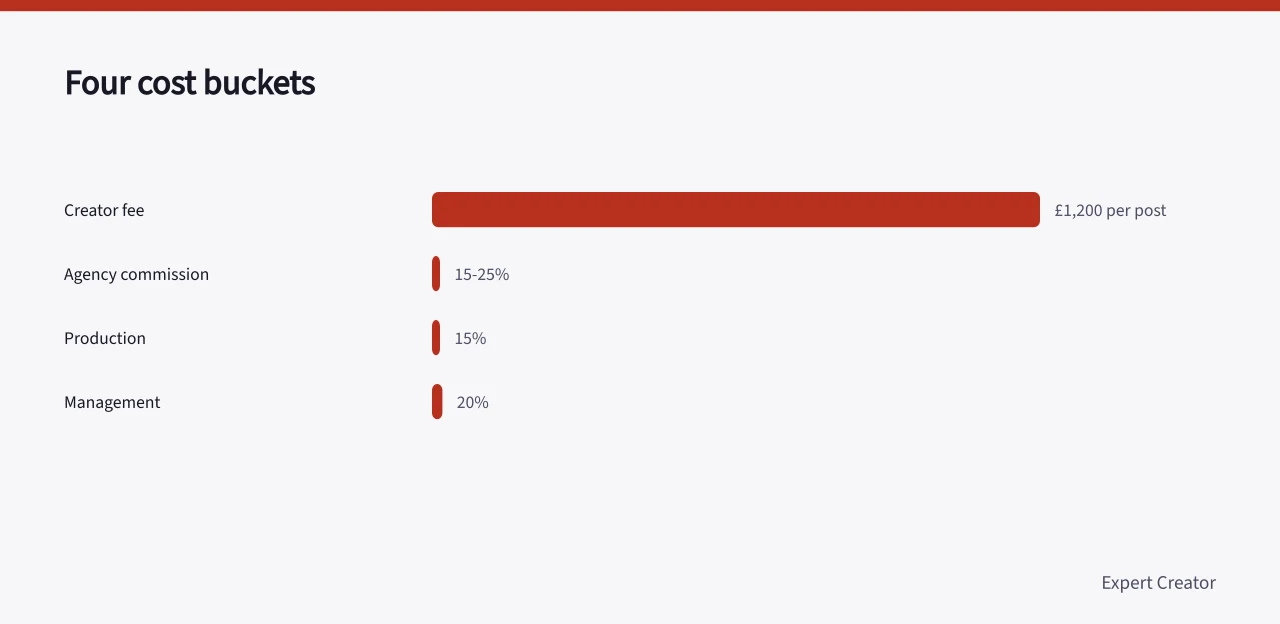
Third, production: briefing, editing, compliance review and any paid media behind the post. Fourth, internal resource, whether a marketing manager's time or a dedicated programme lead.
Each bucket behaves differently. Creator fees are negotiable and scale with scope. Agency fees are often fixed retainers. Production costs are usually passed through at cost. Internal resource is the hardest to see because it hides in salaries and overheads.
Price the smallest useful campaign, then multiply. For example, one creator post costs £1,200, so six posts across three creators need a creator budget of £7,200 before agency or production.
Add 20 per cent for management and 15 per cent for production, reaching near £9,700, and take that number to finance.
Many teams get this wrong because they compare B2B influencer pricing to consumer campaigns. B2B audiences are smaller and more specialised, so cost per thousand impressions is higher. The trade-off is intent: a single post reaching 4,000 decision-makers can outperform a consumer campaign reaching 400,000.
For a full breakdown of how creators and agencies quote, see the guide to B2B influencer marketing pricing models in England.
What do creators charge for B2B campaigns?
Creator rates in B2B vary more than in consumer marketing because the audience is narrower and the creator's credibility is the product. A specialist consultant with 8,000 LinkedIn followers in a regulated sector may charge more per post than a generalist with 80,000 followers.
Creator rate cards
Deliverable
- Niche expert, one LinkedIn post
- £500-£1,500
- Mid-tier creator, post plus comments
- £1,500-£4,000
- Senior figure, post plus webinar
- £4,000-£12,000
- Multi-part thought leadership series
- £10,000-£35,000
Illustrative rate
- Niche expert, one LinkedIn post
- Mid-tier creator, post plus comments
- Senior figure, post plus webinar
- Multi-part thought leadership series
Typical England rates for a single deliverable:
- Niche expert, one LinkedIn post
- £500 to £1,500.
- Mid-tier B2B creator, one post plus comments
- £1,500 to £4,000.
- Senior industry figure or analyst, one post plus a webinar
- £4,000 to £12,000.
- Multi-part thought leadership series across a quarter
- £10,000 to £35,000.
These are planning figures, not market averages. Real quotes depend on exclusivity, usage rights, whether the creator can name your brand, and how much editing you require.
Usage rights are the most common source of cost creep. If you want to run the creator's content as a paid ad for six months, expect to pay an additional 20 to 50 per cent of the original fee. Exclusivity in a category can double the fee because the creator turns down other work.
Payment terms also affect price. Creators who invoice through a limited company may charge VAT. Sole traders may not. Always ask for the invoicing entity before you compare quotes.
How much should you budget for a pilot programme?
A pilot is the right starting point for most B2B teams because it tests fit before you commit to a retainer. A three-month England pilot with three creators, one deliverable each, plus light paid amplification, typically lands between £8,000 and £30,000.
Pilot budget split
- Creator fees55-65%
- Agency or management10-20%
- Production10-15%
- Paid amplification10-15%
- Contingency10%
That range assumes you manage the programme in-house. If you use an agency, add 15 to 25 per cent. If you need original video production, add £3,000 to £10,000 per shoot day depending on crew and location.
A sensible pilot budget splits roughly as follows:
- Creator fees55
- Agency or management10
- Production10
- Paid amplification10
- Contingency10 per cent
| Line item | Share of pilot budget | Illustrative cost on a £20,000 pilot |
|---|---|---|
| Creator fees | 55 per cent | £11,000 |
| Agency or management | 15 per cent | £3,000 |
| Production | 10 per cent | £2,000 |
| Paid amplification | 10 per cent | £2,000 |
| Contingency | 10 per cent | £2,000 |
| Total | 100 per cent | £20,000 |
These percentages are illustrative. The point is to force a conversation about each line before you brief creators.
If you are building the numbers from scratch, a structured B2B influencer marketing budget template will save you from missing the lines that finance always asks about, such as VAT treatment and contractor classification.
Which employer costs apply to creators and staff?
This is where B2B budgets in England often go wrong. Creators are usually self-employed, so you pay their invoice and they handle their own tax. But if you direct how, when and where they work, HMRC may treat them as employees. That reclassification changes your cost base significantly.
Employer cost example
- £45,000 | Marketing manager salary
- £50,000-£52,000 | True employer cost
- £5,000-£7,000 | Added NI and pension
Employer National Insurance, pension contributions and apprenticeship levy thresholds all apply once someone is on payroll. HMRC publishes current figures in its Rates and thresholds for employers 2025 to 2026 guidance; the 2024 to 2025 page at Rates and thresholds for employers 2024 to 2025 is historical. Check the latest employer guidance before modelling any in-house hire.
For a marketing manager on £45,000, an illustrative calculation using 2025 to 2026 employer thresholds gives a true employer cost of roughly £52,000 once you add employer National Insurance and pension contributions. That is the number to compare against an agency retainer.
Contractor status is not just a tax question. It affects how much control you have over content. A creator who is genuinely self-employed can refuse edits. A creator on payroll cannot. Decide which model you need before you negotiate the fee.
How do you price paid amplification?
Paid amplification is the line most B2B teams underestimate. Organic reach from a creator post is useful, but it rarely reaches the full target account list. Putting budget behind the best-performing post extends its life and lets you target specific job titles.
LinkedIn CPM planning assumption
£25-£60 CPM
Targeting senior decision-makers in England
Narrow targeting pushes cost higher
Broad targeting lowers cost but reduces relevance
LinkedIn is the default channel for B2B amplification. Costs depend on targeting, format and competition for the audience. The platform publishes its own guidance at LinkedIn Advertising Costs & Pricing, which is the right starting point for a media plan.
As a planning assumption, a B2B campaign targeting senior decision-makers in England might run at a cost per thousand impressions of £25 to £60. Narrow targeting pushes that higher. Broad targeting brings it down but reduces relevance.
Amplification also changes your contract with the creator. If you are running their content as an ad, you need explicit usage rights, and those rights cost money. Build them into the original fee negotiation rather than coming back later.
For a wider view of where budgets are moving, including the shift toward always-on creator programmes, the analysis in B2B influencer marketing: trends and outlook is worth reading before you set a multi-year number.
What compliance costs should you plan for?
Compliance is not free. Every paid partnership must be clearly disclosed, and the rules apply whether the creator is a household name or a niche consultant. In the UK, the Advertising Standards Authority enforces the CAP Code, which requires ads to be obviously identifiable.
Compliance review cost
- £500-£2,000Legal or regulatory check per campaign
- CAP CodeUK ad disclosure rules
- DSAEU transparency obligations
The EU Digital Services Act adds another layer for campaigns that reach audiences in the EU. It sets platform obligations around transparency and advertising, which affects how content is labelled and how data is handled. UK marketers running cross-border activity should read the Digital Services Act package before briefing creators who publish into EU markets.
Closer to home, the directly relevant UK rules for misleading commercial practices are the Consumer Protection from Unfair Trading Regulations and the CMA's Green Claims Code. The Climate Change Act 2008 sets decarbonisation targets, but it is not the main compliance framework for creator campaigns.
Budget for compliance review. A legal or regulatory check on a creator contract and content brief typically costs £500 to £2,000 per campaign. That is cheap compared with a ruling against you.
Should you use an agency or manage creators directly?
Agencies charge for access, coordination and risk management. If you have no creator relationships and no internal process, an agency retainer of £3,000 to £10,000 a month is often cheaper than building the capability yourself.
Agency or direct management?
Do you have creator relationships and internal process?
Manage directly, lower fees, more control
Use agency, £3,000-£10,000 monthly retainer
Direct management works when you already know the creators you want and can handle contracts, briefs and payments. It gives you more control and lower fees, but it consumes internal time. A programme manager spending two days a week on creator work is a real cost, even if it does not appear as an invoice.
Procurement teams increasingly ask for evidence that a creator or vendor can deliver. Analyst evaluations such as the Forrester Wave are useful for due diligence when you are comparing agencies or platforms at scale, though most B2B creator programmes are too small to justify a formal analyst review.
A hybrid model is common. Use an agency for sourcing and contracting, then manage the ongoing relationship in-house. That keeps the strategic work close to your team while outsourcing the administrative load.
What hidden costs should you watch for?
Hidden costs in B2B influencer marketing rarely appear in the first quote. They appear in the second invoice. The most common are usage rights extensions, reshoots, additional editing rounds, and travel or event attendance.
Hidden cost checklist
- Usage rights extensions
- Reshoots and additional editing rounds
- Travel or event attendance
- Internal coordination per creator
- One or two underperforming deliverables
Another is the cost of internal coordination. Every creator needs a brief, a contract, a content review and a payment run. If you have ten creators, that is ten of each. The administrative load scales faster than the media spend.
Set a contingency of 10 to 20 per cent of creator and production spend. On the £20,000 pilot above, that is £2,000 to £4,000, which covers one underperforming deliverable or a reshoot.
A detailed breakdown of the costs that catch teams out is available in the guide to B2B influencer marketing hidden costs in England.
Finally, measure return properly. Cost per engagement is easy to calculate but rarely convinces a finance director. Pipeline influence, cost per qualified meeting and revenue attribution are harder but more useful. The framework in B2B influencer marketing return on investment explains how to connect creator spend to commercial outcomes.
Glossary
- Creator fee:
- payment to an individual or company for producing and publishing content.
- Usage rights:
- permission to reuse creator content in paid media or owned channels, usually time-limited.
- Exclusivity:
- a clause preventing the creator from working with competitors for a set period.
- Paid amplification:
- advertising spend behind a creator post to extend reach.
- Retainer:
- a recurring fee for ongoing agency or creator services.
- Contingency:
- a buffer for unexpected costs, typically 10 to 20 per cent.
Common questions
What is a realistic minimum budget for B2B influencer marketing?
A single-creator pilot with one deliverable and no paid amplification can be run for £2,000 to £5,000. Below that, you are usually asking for a favour rather than buying a service.
Do B2B creators charge more than consumer creators?
Often yes, per post. B2B audiences are smaller, so creators charge for expertise and access rather than reach. A niche consultant may charge more than a lifestyle creator with ten times the followers.
Is agency commission always 15 to 25 per cent?
No. Commission varies with scope and contract length. Some agencies charge a flat project fee instead. Always ask for the fee structure in writing before comparing quotes.
How should I account for VAT on creator fees?
Ask whether the creator is VAT-registered. If they are, VAT is added to their invoice and may be recoverable by your business. If they are not, no VAT applies. Treat this as a cash-flow question as well as a cost question.
In this guide
- Why a B2B influencer marketing cost guide beats a single fee quoteA B2B influencer marketing cost guide for UK teams: creator fees, employer costs, platform spend and reporting hours, with labelled figures and a worked table.
- Five B2B influencer marketing pricing models and what each one costsFive B2B influencer marketing pricing models compared, with labelled pound examples and the commercial assumptions buyers should test before signing.
- How to structure a B2B influencer marketing budgetA B2B influencer marketing budget can separate creator fees, production, media, rights and compliance, then phase spend around reviews and approvals.
- Return on investment in B2B influencer marketing needs a defined methodHow to calculate B2B influencer marketing return on investment: cost inputs, attribution choices, a worked pound example and compliance checks.
- Where hidden costs arise in B2B influencer marketingB2B influencer marketing costs can arise at contract, review, publication and renewal stages. See where rights, disclosure and whitelisting enter.