
Reviews
Why B2B influencer marketing reviews need a method before a score
How to run B2B influencer marketing reviews: verify providers, score them on evidence, check compliance and compare platforms without trusting vendor claims.
What to take away
- LinkedIn's own marketing certification page states that its certifications are earned by passing an exam, so a badge proves exam knowledge rather than delivery quality on your account.
- Verify the legal entity before you score anything elseCompanies House records show incorporation date, filing history and registered address, which is where provider claims either hold up or fall apart.
- Compliance is a scored criterion, not a footnote. The ICO's direct marketing guidance and ASA rulings both give you citable tests for consent, disclosure and targeting.
- Compare providers on the same weighted criteria, then revisit the weighting each quarter, because a channel that suited a six-month thought leadership push may not suit a product launch.
- Keep an audit trail of scores and evidence. It is the only defence when procurement, legal or a new marketing director asks why a supplier was chosen.
Start with verification, not scoring
Most review processes begin with a scorecard. That is the wrong order. A scorecard applied to an unverified supplier produces confident numbers about a company that may not exist in the form described.
Provider verification gate
- Search registered name on Companies House
- Match company number to contract and invoice
- Check filing dates and dormant accounts
- Check directors across dissolved companies
- Pass or leave the process
Verification is mechanical and cheap. It takes an hour per shortlisted provider and removes the worst candidates before they consume scoring time. Treat it as a gate: pass, or leave the process.
Check the legal entity and its filing history
Search the provider's registered name on the official Companies House register, not the trading name on the pitch deck. Confirm the company number matches the entity named on the contract and the invoice.
Look at filing dates. A company incorporated eight months ago can still be excellent, but its claims about a decade of sector experience need explaining. Check for dormant accounts, late filings or a registered address shared with dozens of unrelated firms.
Also check who the directors are and whether they appear across several dissolved companies. None of this is disqualifying on its own. It changes the questions you ask.
Verification has limits. It confirms the supplier is real and that its filings are current. It tells you nothing about whether the people who pitched will be the people who deliver your campaign.
Match claimed skills to verifiable evidence
Provider decks often list platform certifications. These are worth checking against the awarding body rather than the provider's screenshot. For example, LinkedIn's advertising certification programme sets out how its exams are structured and what passing them means.
A certification tells you someone passed an exam. It does not tell you who will run your campaign, how they handle a creator dispute, or what happens when a post underperforms. Ask for named team members and their role on your account.
Ask which named individual holds each badge, and whether that person sits on your account team or elsewhere in the business. Certifications held by a sales lead are marketing material, not delivery evidence.
If the provider publishes reviews of its own, read how agency reviews in England are structured to see what a defensible evidence set looks like before you accept theirs.
Build a scorecard you can defend
The scorecard is the core of any B2B influencer marketing review that survives scrutiny. It converts opinion into weighted criteria, and it forces every reviewer to justify a number with a source.
Illustrative scorecard weightings
- Compliance25%
- Audience relevance20%
- Measurement20%
- Creative approach15%
- Commercial terms10%
- References10%
Keep it to six or seven criteria. More than that and reviewers start guessing. Fewer and you miss the risks that matter most in business-to-business work: audience quality, disclosure practice and measurement honesty.
Before scoring a real provider, run a calibration session. Give two reviewers the same evidence pack for a practice supplier and compare their marks. Where they differ by more than one point, the criterion wording is usually at fault.
Use a five-point scale with written anchors at the low, middle and top positions. Anchors stop reviewers drifting towards the middle, which is the most common way a scorecard produces a tidy but useless result.
Weight the criteria before you see the scores
Agree weightings with everyone who will sign off the contract. If procurement cares most about data handling and the marketing lead cares most about creator fit, both should influence the weighting before any provider is scored.
An illustrative example: a team weighting compliance at 25 per cent, audience relevance at 20 per cent, measurement at 20 per cent, creative approach at 15 per cent, commercial terms at 10 per cent and references at 10 per cent. A provider scoring well on creative but poorly on compliance cannot win under those weights.
Record the weighting rationale in one paragraph. When a losing provider asks why they were not selected, you have an answer that is not a matter of taste.
Score only against evidence you have seen
Every score needs a source next to it: a filing, a policy document, a named reference call, a published rate card or a platform's own documentation. A verbal assurance in a pitch meeting is not evidence.
Build a written evidence pack for each provider and share the same pack with every reviewer. When one reviewer has seen a document the others have not, scores stop being comparable.
For a full breakdown of how to run this process, including reviewer calibration and conflict-of-interest declarations, use a documented review methodology for B2B influencer marketing rather than inventing one per tender.
Where providers look close on paper, the tie-breaker should be a paid pilot with agreed success measures, not a longer presentation. A pilot produces evidence. A presentation produces confidence.
Score compliance and measurement properly
Compliance and measurement are where business-to-business influencer campaigns most often fail, and where review processes are usually thinnest. Both are testable if you know which sources to check.
Compliance and measurement checks
- Lawful basis for each data flow
- Process when a contact objects
- Retention period in months
- Deletion process at work end
- Follower authenticity checks
- Audience business relevance review
A provider that cannot explain how it handles personal data, or how it labels paid content, is a risk regardless of its creative record. Score both explicitly and require documentary answers.
Test data handling and disclosure against published rules
The ICO's direct marketing guidance for organisations covers consent, legitimate interests and the privacy rules that apply when you contact business audiences through creators and experts.
Ask providers to describe their lawful basis for each data flow: creator lists, lead capture, retargeting and event follow-up. Ask what happens when a contact objects. Vague answers should reduce the score.
Ask about retention as well. How long does the provider keep creator lists, lead records and campaign reporting data, and how does it delete them when the work ends? An answer in months beats an answer in good intentions.
Creator vetting belongs in the same pass. Ask how the provider checks follower authenticity, and whether it reviews a creator's audience for business relevance before sending a brief.
For creative and disclosure practice, the IAB UK introduction to creative best practice is a useful reference for how digital advertising formats, including influencer placements, should be built and labelled.
Contract terms belong in the same review. Check who signs the creator agreements, who owns those relationships at the end, and what happens to content rights once the campaign stops.
When a provider claims its approach has never attracted a complaint, check the regulator's published decisions. The ASA rulings database is searchable by sector and advertiser, and it is a faster reality check than any reference call.
Insist on measurement that survives a board review
Ask what the provider will report, at what cadence, and from which source system. Then ask what it will not report. Providers that measure everything usually measure nothing well.
For B2B work, agree a small set of primary measures before the campaign starts. Pipeline influence, qualified meetings and content-assisted conversions are more useful than impressions alone. Secondary measures can include reach, engagement and share of voice.
Insist on a control group or a holdout where the budget allows. Without one, attribution claims are assertions. Document the measurement plan in the contract schedule so it cannot be quietly revised at the reporting stage.
Agree who signs off the numbers and what happens if a target is missed. A reporting pack reviewed once at the end has less value than one reviewed monthly with an agreed owner.
Compare options without being led by them
Comparison is where review processes are most easily captured by vendor framing. Providers define the categories, supply the case studies and often write the questions procurement asks.
Counter this by comparing like with like. A specialist creator agency and a platform's managed service are different products, and scoring them on one grid rewards whichever one the grid was designed for.
Total cost is where comparisons usually go wrong. Platform fees, retainer, creator fees, production and measurement tooling are often quoted separately, so build a single three-month view before you compare anything.
Separate platform capability from service quality
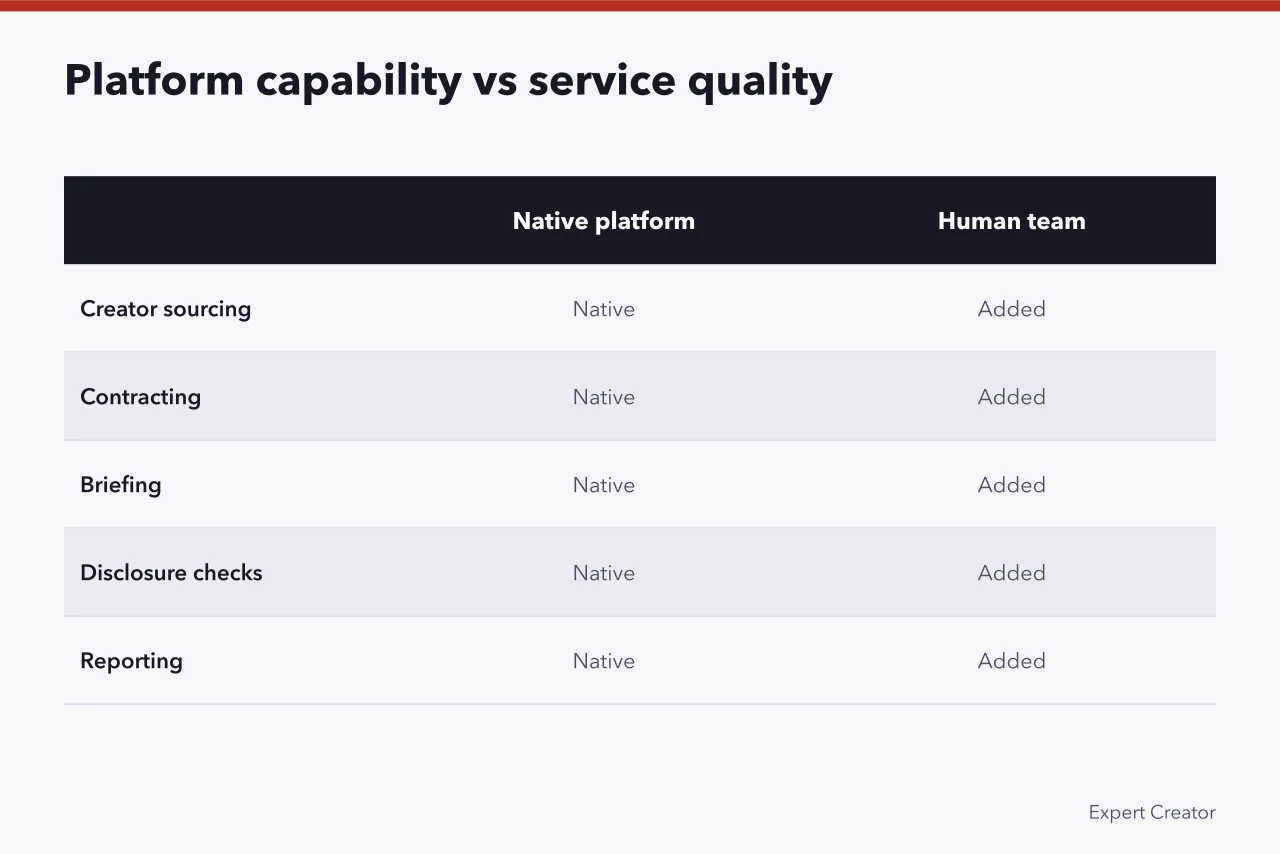
For each option, record what the platform does natively and what a human team must add. Creator sourcing, contracting, briefing, disclosure checks and reporting are separate capabilities, and few providers do all of them well.
Native reporting rarely answers the questions a board asks. Record which measures need a person to assemble them, and which team carries that work each month.
A structured product comparison for B2B influencer platforms helps you map these capabilities side by side without accepting a vendor's own category definitions.
Use the same test data across demos. Give every provider the same brief, the same budget range and the same constraints, then compare what they propose. Differences in approach become visible quickly.
Run a shortlist checklist before you commit
Use this checklist for every finalist, and store the completed version with the scorecard. Each line needs a named owner and a date, otherwise the checklist becomes a formality.
Shortlist checklist
- Legal entity verified on Companies House, with company number matching the contract.
- Named account team confirmed in writing, including who owns escalation.
- Two reference calls completed, at least one with a client who left.
- Lawful basis documented for every data flow, per ICO guidance.
- Disclosure and labelling process described in writing, with examples.
- Measurement plan agreed, including any holdout or control group.
- Commercial terms include exit, notice period and data return or deletion.
- Conflict-of-interest declaration signed by each reviewer.
A shorter version of this list, adapted for tender packs, sits in our selection checklist for B2B influencer providers.
On reference calls, ask what the provider got wrong and how it responded. A client who stayed after a difficult quarter tells you more than one who never had a problem.
Keep the review current
The channel moves faster than annual procurement cycles. Creator pricing, platform features and disclosure expectations shift within a year, so a scorecard completed last spring may be misleading by autumn.
Review cycle triggers
- At signatureSet review date
- AnnuallyRe-score incumbent and alternative
- Change of ownershipOut-of-cycle review
- Account lead departsOut-of-cycle review
- Price rise above thresholdOut-of-cycle review
- Second reporting failureOut-of-cycle review
Set a review date at contract signature. Re-score the incumbent against the same criteria and at least one credible alternative. This is not disloyalty; it is how you keep pricing and service honest.
Set triggers for an out-of-cycle review as well: a change of ownership, the departure of the named account lead, a price rise above an agreed threshold, or a second failure on reporting.
Watch for structural changes too. Changes in how platforms verify audiences, how creators price business work and how regulators interpret disclosure all affect what a good provider looks like. Our outlook on B2B influencer marketing trends tracks the shifts most likely to change your criteria.
Finally, keep a short written record of what you learned from each review cycle: which criteria predicted a good outcome, which were noise, and which evidence was hardest to obtain. That record, not the scorecard template, is your real advantage in the next tender.
Common questions
How long should a B2B influencer marketing review take?
For a shortlist of four to six providers, allow three to five weeks. Verification and reference calls take the longest, and rushing them is where most processes fail.
Should I score providers on follower counts?
No. Follower counts are easy to inflate and say little about business audience quality. Score audience relevance, engagement quality and evidence of past performance with comparable clients instead.
What if a provider refuses to share its compliance documentation?
Treat that as a failed criterion rather than a negotiation. You need the lawful basis for data flows, the disclosure process and the measurement plan in writing before contract signature.
Can I rely on platform certifications during selection?
Use them as one small piece of evidence. A certification shows someone passed an exam, so pair it with named team members, references and a paid pilot before making a decision.
In this guide
- A B2B influencer marketing review methodology you can defendHow to build a B2B influencer marketing review methodology: what to assess, what to exclude, and how to tell vendor claims from independent evidence.
- When to compare B2B influencer marketing providers: Onalytica, Traackr, Upfluence and moreWhen to compare B2B influencer marketing providers such as Onalytica, Traackr and Upfluence, plus criteria and due diligence for England-based buyers.
- Before you choose a B2B influencer marketing product, weigh suite against point toolA practical contrast between platform suites and point tools in a B2B influencer marketing product comparison, with evidence checks and scoring for UK teams.
- How should you read B2B influencer marketing agency reviews?What a B2B influencer marketing agency review can and cannot tell you, how to separate vendor claims from independent evidence, and how to score a shortlist.
- Before you shortlist a creator, run a B2B influencer marketing selection checklistA B2B influencer marketing selection checklist covering audience evidence, disclosure, data provenance and a weighted scoring rubric for UK teams.